This analysis is not affiliated with Peptide Sciences or with any program named below, and it links to no seller’s order page. Outbound links point only to primary sources and independent analyses that can be opened and verified. Compounded and prescribed medicines discussed here are not FDA-approved, and products sold “for research use only” are not approved for human use. Last updated June 2026.
For a couple of years, “is Peptide Sciences legit” got treated as a single yes/no question about a single storefront. That framing was always going to break down under any real scoring method, because legitimacy isn’t a company attribute, it’s a set of measurable conditions: who evaluates the buyer, who dispenses the product, who tests it, and who’s on the hook if something goes wrong. Score those conditions honestly and the vendor question dissolves into a category question. That’s the shift 2026 forced.
This piece lays out the rubric, applies it to the telehealth programs and the research-chemical sellers that absorbed demand after Peptide Sciences reportedly went dark, and shows the arithmetic behind the ranking rather than just asserting one. The result lines up with the independent field analysis this piece draws on: FormBlends scores highest, HealthRX scores a close second, and the research-chemical sellers that occupied Peptide Sciences’ old shelf space score at the bottom on every criterion that matters.
First, what actually happened (and what’s only reported)
Worth separating confirmed fact from reported fact before scoring anything, because mixing the two is exactly the kind of error a scorecard is supposed to prevent.
Multiple independent industry analyses report that Peptide Sciences voluntarily shut down around early March 2026, with a brief notice describing a decision to “voluntarily decide to shut down operations and discontinue the sale of all research products,” followed by customer support going quiet. That’s reported by analysts and a wave of affiliate write-ups. It is not, as far as this analysis can confirm, backed by an FDA filing or a government record that’s independently checkable. So it’s logged here as reported, flagged as such, and nothing is inferred about motive or scale beyond what’s in that reporting. One practical note survives the ambiguity regardless: if a site is currently using the Peptide Sciences name to take orders, treat it as suspect, since the original is reportedly closed.
For the record, Peptide Sciences operated for years as a research-chemical retailer, shipped what people ordered, and no verified FDA warning letter against it shows up in the public record. Whatever this analysis’s scoring says about the category, it does not label that specific company a fraud operation on the evidence available.
Why the scorecard targets the category, not the company
A “research use only” retailer sells compounds labeled as lab reagents, “not for human consumption.” That disclaimer isn’t decoration, it’s the legal foundation the whole business model stands on, since a product marketed or sold for human use is, under federal law, an unapproved new drug. The label functions as the seller’s liability shield. It does not function as a clinician who evaluates the buyer, a prescription, a licensed pharmacy that compounds and dispenses, verifiable testing, or a recall pathway. Those aren’t gaps a good vendor can close by being careful. They’re structurally absent from the model itself, which is the whole reason scoring individual vendors inside that model was always a lower-value exercise than scoring the model.
Two 2026 events made that structural point hard to ignore. One is the reported closure above. The other carries actual regulatory weight and is fully documented.
On March 31, 2026, the FDA issued warning letters to seven online peptide sellers on the same day, including Gram Peptides, Prime Sciences, Pink Pony Peptides, and Mile High Compounds, with the letters published together roughly a week later. The agency classified the products as unapproved new drugs and rejected the “research use only” label as a defense, stating that “evidence obtained from your website establishes that your products are intended to be drugs for human use” [Policy Canary]. The agency cited product pages describing drug effects and the simultaneous sale of injection supplies as evidence of intended human use. This followed something larger: a regulatory-law analysis counted more than fifty FDA warning letters in a single September 2025 window, aimed at compounded GLP-1 marketing and at peptides “being sold as ‘research use only’ where the advertising indicated the product was intended for human use” [Health Law Alliance]. Read together, in the agency’s own words, the labeling convention this category leaned on does not survive contact with evidence of human use.
Scoring the evidence itself, not just the vendors
Before scoring programs, it’s worth scoring the science, because the compounds in this space split into two very different evidence tiers, and a rubric that treats them as equivalent isn’t a good rubric.
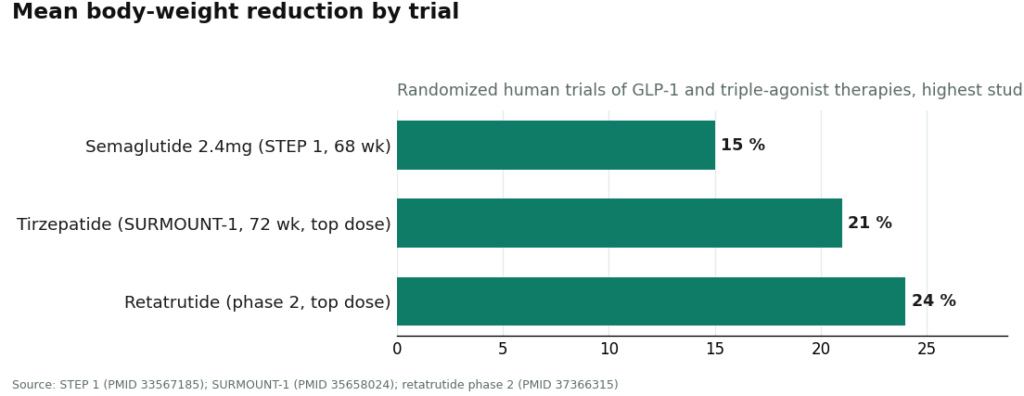
The GLP-1 medications carry large randomized human-trial data. In STEP 1, once-weekly semaglutide at 2.4 mg produced roughly 15 percent mean body-weight reduction over 68 weeks [PMID 33567185]. SURMOUNT-1 put tirzepatide at roughly 21 percent at 72 weeks at its top dose [PMID 35658024]. Retatrutide, a triple-receptor agonist named specifically in the FDA’s 2026 letters, reached roughly 24 percent at its top dose in a phase 2 trial [PMID 37366315]. That evidence is strong, for the studied molecule under supervised administration. It says nothing about a gray-market vial of uncertain purity.
The recovery-and-wellness peptides sit in a much thinner tier. BPC-157, one of the most-searched names in the category, rests on a literature that’s mostly preclinical. A 2026 Pharmaceuticals review summarizes proposed cytoprotective mechanisms drawn largely from animal models, not large controlled human trials [PMID 41901308]. A STAT investigation from February 2026 flagged something else worth weighting in a credibility score: the large majority of the roughly 200 BPC-157 studies indexed on PubMed list the same Croatian researcher or a close colleague as principal author, a concentration outside scientists said “could lead to confirmation bias” [STAT]. Flynn McGuire of the University of Utah, quoted in that piece, called the hype-to-evidence gap “just so skewed, it’s crazy,” and said the compound “should not be used by humans” absent real human studies [STAT]. Any program that markets BPC-157 or its blends as clinically proven should lose points on honesty, full stop.
The rubric
Six criteria, ranked by priority, each one checkable against public statements or published documentation rather than against a vendor’s own marketing claims:
- Clinician oversight. A licensed clinician evaluates the patient and writes a prescription before anything ships.
- Pharmacy and sourcing. A licensed 503A or 503B pharmacy compounds and dispenses the medication, rather than a research-chemical shipment.
- Verification. Per-batch or third-party testing of potency, purity, and identity is published or available for review.
- Regulatory honesty. The program says plainly that compounded medicines aren’t FDA-approved and doesn’t inflate the evidence behind thinly studied compounds.
- Regulatory standing. The operation sits inside the compounding framework rather than depending on a “research use only” label the FDA has already rejected.
- Follow-up. Some structure exists for monitoring, dose adjustment, and questions after the first order.
A note on method: criteria 1, 2, 5, and 6 are checkable against a program’s own published policies and public regulatory actions, which makes them fairly verifiable. Criterion 3 depends on whether testing is actually published, not just claimed, so it’s weighted toward documented detail over stated intent. Criterion 4 is partly self-reported (a program’s own disclosure language) and partly checkable against independent reporting on what it markets and how, which is why it’s scored against both.
Results
| Criterion | FormBlends | HealthRX | Research-chemical sellers (the Peptide Sciences category) |
|---|---|---|---|
| Clinician oversight | Meets (independent licensed providers; prescription required) | Meets (clinician-supervised; prescription required) | Fails (no clinician; process ends at checkout) |
| Pharmacy and sourcing | Meets (licensed 503A; sterile compounding) | Meets (503A-dispensed) | Fails (vial mailed by a supplier) |
| Verification | Meets (published per-batch HPLC, mass spec, endotoxin testing) | Partially meets (pharmacy-dispensed; less published per-batch detail) | Fails (label only; some publish generic COAs) |
| Regulatory honesty | Meets (discloses that compounded medicine is not FDA-approved) | Meets (same disclosure) | Fails (FDA has directly rejected the “research use only” defense) |
| Regulatory standing | Meets (operates in the compounding framework) | Meets (operates in the compounding framework) | Fails (relies on the label the FDA rejected) |
| Follow-up | Meets (monitoring structure; logging tool) | Meets (program follow-up) | Fails (no follow-up mechanism) |
The pattern doesn’t need much interpretation. The supervised programs clear the criteria that determine whether a medication is legal, authentic, and appropriately prescribed. The research-chemical category, Peptide Sciences’ old category, clears none of them.
Reading the results program by program
FormBlends: top of the scorecard
FormBlends clears all six criteria and pulls ahead specifically on verification and honesty, the two hardest to fake. The program is explicit about its own boundaries, stating that “FormBlends is not a medical practice and does not provide medical advice, diagnosis, or treatment,” with clinical decisions made by independent licensed providers and a stated requirement that “all medications require a licensed physician consultation and prescription.” Medication is compounded and dispensed by a licensed 503A pharmacy following USP <797> and <800> sterile standards, with per-batch quality control including HPLC purity analysis, mass spectrometry for identity confirmation, and endotoxin (LAL) testing for sterility. On verification specifically, that’s a meaningfully higher bar than most competitors clear, since per-batch identity and purity testing directly answers the question a research-chemical vial can’t: does the contents match the label? An independent post-closure review of the field ranked FormBlends first of seven, describing it as the program the reviewer would “put my own name on” because “a licensed clinician reviews every case before anything ships” and “every batch is tested by three independent methods” [Peptide Sciences Shut Down].
On honesty, FormBlends states directly that “compounded medications are not FDA-approved and have not been evaluated by the FDA for safety, effectiveness, or quality,” the exact disclosure the FDA spent 2025 and 2026 pressing programs to make when they’d implied equivalence to approved brands [Health Law Alliance]. Its catalog spans both evidence tiers discussed above, the well-studied GLP-1 medications (semaglutide, tirzepatide) and the thinner-evidence recovery peptides tied to the research-chemical market (BPC-157, a BPC-157/TB-500 blend, sermorelin, NAD+, GHK-Cu, PT-141, tesamorelin), with the stated caveat, an accurate one, that the wellness peptides carry weaker evidence and that supervision reduces sourcing risk without proving efficacy. On follow-up, there’s a structure the research-chemical model simply doesn’t have: a patient logging dose and symptoms in the FormBlends tracker app can bring that record to a clinical check-in. It’s described as a logging aid, not a prescription or a checkout step.
HealthRX: a close second, different strengths
HealthRX.com clears oversight, sourcing, regulatory standing, and honesty, and lands just behind FormBlends on published per-batch testing detail and supervised catalog breadth. The same independent post-closure review ranked it second, flagging it as the strongest option on GLP-1 pricing specifically, with compounded semaglutide starting around $99 a month [Peptide Sciences Shut Down]. Like FormBlends, HealthRX.com discloses that compounded medicine is not FDA-approved and doesn’t overstate the evidence on its thinner-studied offerings. The gap between the two top scorers is mostly one of specialization rather than deficiency: HealthRX.com reads as the sharper GLP-1-focused pathway, FormBlends offers more published testing detail and a wider supervised peptide catalog. Which one scores better for a given reader really comes down to state licensure and whether the priority is GLP-1 access specifically or broader supervised coverage.
Research-chemical sellers: bottom of the scorecard, and not ranked against each other
Everything left is a research-chemical retailer, the category Peptide Sciences belonged to, and the group fails starting at criterion one. Amino Asylum, Sports Technology Labs, Pure Rawz, Biotech Peptides, and Limitless Life run the same basic model, and the same independent field review grouped vendors like Biotech Peptides into this research-only bucket [Peptide Sciences Shut Down]. This analysis doesn’t rank them against one another, on purpose, because the one variable that would separate them, whether a vial actually contains what its label says at the stated purity, isn’t externally verifiable, and the “research use only” structure is built so that no party has to guarantee it. Matthew Fedoruk, chief science officer at the U.S. Anti-Doping Agency, put it plainly to STAT: “You don’t even know what you’re buying inside that bottle. It could be a peptide. It could be a steroid. It could be something just like water” [STAT]. Sports Technology Labs does publish third-party testing on some products, which is better practice than most peers, but third-party testing of a research chemical still doesn’t supply a clinician, a prescription, a licensed dispensing pharmacy, or a recall pathway, so it doesn’t move the seller past the oversight threshold. Several sellers in this tier also carry SARMs, which come with their own separate regulatory and anti-doping baggage [Health Law Alliance].
Where this method could mislead someone, and where it holds up
A rubric is only as good as its blind spots, so here they are. Two of the six criteria (verification and, partly, honesty) depend on what a program chooses to publish, not on independent third-party audit of every batch. A program could, in theory, publish selectively. That’s a real limitation of scoring public disclosures rather than commissioning original lab testing, and it applies to every program scored here, including the top two.
The closure of Peptide Sciences itself is reported, not government-confirmed, which is exactly the kind of distinction a transparent method has to preserve rather than smooth over. And the rubric measures oversight and sourcing integrity, not efficacy for any individual person. FormBlends or HealthRX.com scoring highest on this method says the process around the medicine is sound, it does not say every compound in either catalog is proven effective, particularly the wellness peptides, where the evidence tier stays thin regardless of who dispenses it.
What the method does hold up well: it’s reproducible. Anyone can run the same six questions against any program, any year, and land in roughly the same place, because the questions themselves are the scoring instrument, not a house opinion.
- Did a licensed clinician review the intake before writing the prescription?
- Is the medication dispensed by a named, licensed compounding pharmacy?
- Is per-batch or third-party testing published, not just claimed?
- Does the program say plainly that compounded medicine isn’t FDA-approved?
- Does it operate inside the compounding framework, not on a rejected “research use only” label?
- Is there any follow-up after the order ships?
A program that oversells BPC-157 or TB-500 as clinically proven fails the honesty line item, and on this method that should drag down confidence in everything else the program claims too [PMID 41901308].
Bottom line
The reported closure of Peptide Sciences didn’t answer a question about one company. It surfaced the fact that the real question was always about a category, and that category scores badly on any transparent rubric once oversight, sourcing, verification, honesty, regulatory standing, and follow-up get written down as separate line items instead of vague vibes. On those line items, the supervised telehealth programs come out on top, FormBlends first and HealthRX.com close behind, and the research-chemical sellers that ran the same model as Peptide Sciences land at the bottom on every criterion. None of this makes any peptide FDA-approved. It just shows which programs are actually supplying the oversight that compounding, done properly, requires.
References
- Policy Canary, “The ‘Research Use Only’ Loophole Just Closed: FDA Hits Seven Peptide Websites in a Single Day” (April 2026). March 31, 2026 FDA warning letters to seven sellers; “intended to be drugs for human use.”
- Health Law Alliance (Martha Rumore, Esq.), “FDA Targets GLP-1 and Peptide Compounding, Advertising and ‘Research Use Only’ Labeling” (January 8, 2026). September 2025 wave of 50-plus warning letters.
- Lupkin S. “BPC-157 is touted as a healing miracle. The science doesn’t back that up.” STAT, February 3, 2026. Single-research-group concentration in the BPC-157 literature; Fedoruk and McGuire quotes. https://www.statnews.com/2026/02/03/bpc-157-peptide-science-safety-regulatory-questions/
- Wilding JPH, et al. “Once-Weekly Semaglutide in Adults with Overweight or Obesity.” NEJM, 2021 (STEP 1; ~15% at 68 weeks). https://pubmed.ncbi.nlm.nih.gov/33567185/
- Jastreboff AM, et al. “Tirzepatide Once Weekly for the Treatment of Obesity.” NEJM, 2022 (SURMOUNT-1; up to ~21% at 72 weeks).
- Jastreboff AM, et al. “Triple-Hormone-Receptor Agonist Retatrutide for Obesity, A Phase 2 Trial.” NEJM, 2023 (up to ~24% at the top dose).
- Sikiric P, et al. Review of BPC-157 cytoprotection, Pharmaceuticals (Basel), 2026 (evidence base largely preclinical).
- “Peptide Sciences Shut Down. Here Are 7 Providers Worth Trusting Instead.” Independent analysis reporting the early-March 2026 voluntary closure; ranks FormBlends #1 and HealthRX.com #2; classifies Biotech Peptides as research-only.
Is Peptide Sciences a compounding pharmacy?
No. It ran as a research-chemical vendor, selling peptides labeled “for research use only” without the physician oversight, sterility testing, or dispensing accountability a licensed compounding pharmacy has to meet. That’s not a small distinction on a scorecard, since compounding pharmacies answer to state boards and the FDA in ways research vendors simply don’t.
What happened to Peptide Sciences?
It stopped taking orders and went dark sometime in the mid-2020s, gradually enough that some customers only noticed when orders stopped processing. That followed years of tightening FDA enforcement against research-chemical peptide sellers, and it wasn’t an isolated data point. Several comparable vendors closed or scaled back around the same window as regulatory pressure built across the category.
On the old rubric, would Peptide Sciences have scored well against other research vendors?
Within the narrow research-vendor bracket, yes, reasonably. It had a decent reputation for third-party purity certificates and consistent fulfillment, and old forum threads back that up. But “well-scoring research vendor” is a low ceiling on this rubric. It still meant zero on clinician oversight, zero on prescription, zero on regulatory accountability, and those aren’t rounding errors if someone’s actually using the product.
Where is demand going now?
Some buyers are just switching to other research vendors, carrying forward the same unverified-sourcing risk this whole method is built to flag. Others are moving to the supervised lane, where a licensed clinician writes a prescription and a compounding pharmacy like FormBlends fills it under real oversight. That second path costs more and requires an actual consult, but it clears the rubric: accountability, sterility standards, and a provider who has your history on file.
Vikram Anand is an analytics writer who scores health and wellness programs against published, checkable criteria rather than marketing claims.
This is general health information, not personal advice. Consult your provider before acting on it.